

Get Up. Act Normal.
Seven years after two bike crashes, what looks like resilience is sometimes just control wearing a costume.

I’m scared of clip-in shoes and pedals.
Seven years out, and there is a nervousness in my body when I climb on Lorenzo Jr., my Cervélo, and take to the road. It still buzzes through me. A steady hum of nerves, even as the wind whips through my hair, and the corners of my lips tilt up as I find the rhythm of the pedaling. It’s like standing below a telephone wire, the hum consistent and at first a bit nerve-racking, but eventually it lulls and becomes second nature and normal, yet the hum can escalate quickly to a heart-pounding, sweat-inducing fear, breaking the calm in a moment. So the fear is still there, laced with memory, waiting for the moment my nerves spike.
Lorenzo Jr. was bought when I was spending the bulk of my time in Bishop, California. My boyfriend at the time and I got matching bikes thanks to an incredible pro deal his stepdad had. His stepdad, his mom, and, honestly, his whole family were huge proponents of outdoor living. His mom let me borrow her 1990s ski suits, one was powder blue with a fur neckline, it was incredible, and even took me down the greens at Mammoth to teach me how to ski. His stepdad was a serious cyclist, the kind who entered the Grand Fondo, and eventually he sold the boyfriend and me on joining the family for road rides all over Bishop.


I wish I could have stayed with that family forever. But eventually, I made my way back to San Francisco and parted ways with the boyfriend and his family. Lorenzo Jr. came home with me and stood unused for months in my shared four-bedroom, one-and-a-half-bathroom apartment, where three other roommates lived.
Until one day, the itch to bike again drove me back into the saddle. I’d loved it when I was east of the mountains, and I’d heard of “the wiggle,” the bike route through San Francisco that helps commuters get through the city with the fewest cars. So one cool spring morning, I turned my walk commute into a bike commute. And my god, I felt powerful and giddy. I always say you can’t be angry on a bike, and the smile that stamped itself on my face for those first miles into work was almost clownish, showing all my teeth, an ad for Colgate.
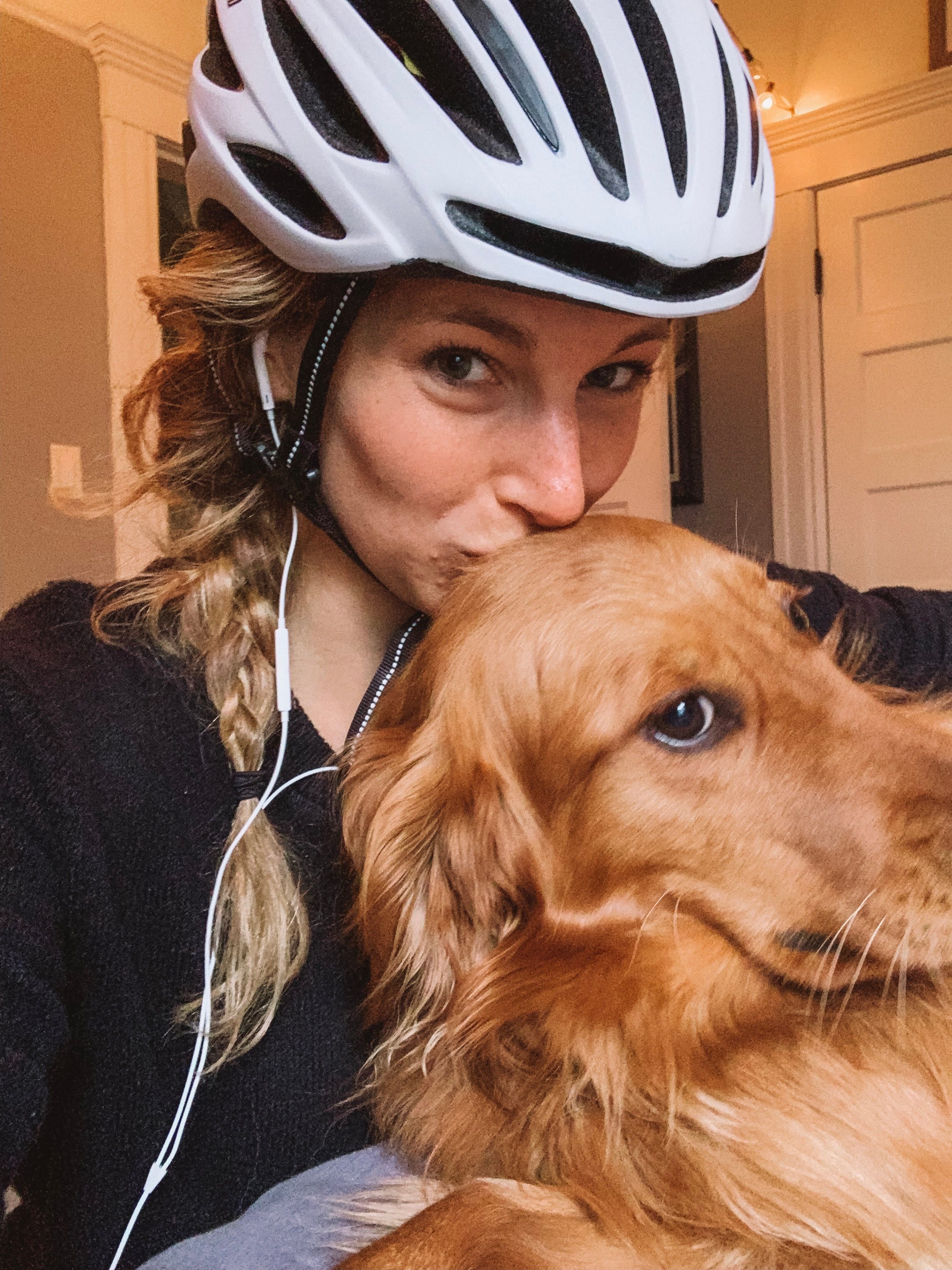
It became a routine, once or twice a week, riding and nodding good morning to the other wigglers. Until one morning, when perhaps I’d grown too confident.
I was pedaling down Market Street, one of the city’s main arteries, toward my office on Mission and Second. I was trying to make the last few seconds of a green light, and right as I did, a car turning right from my side veered into the lane, blocking my access to the bike lane and pushing me out into the trolley tracks. My thin road tires didn’t stand a chance. It felt like an instant before I was on my side in the middle of one of the biggest roads in the city.
Dazed and full of adrenaline, I jumped up as if nothing was wrong. I didn’t want to inconvenience people on their way to work, didn’t want to need help, so I threw my bike over my right shoulder and decided to walk the rest of the way in.
When I got to work, I finally took a breath. As the adrenaline came down, I started taking stock. My helmet had a major crack in it. My bike had scuffs. My overalls had small rips at the knees. But the part that worried me was my shoulder, which felt off in a way I couldn’t name. A few minutes later, my boss walked in, saw my flushed face and disheveled clothes, and told me I should probably see a doctor. The smile on my face slowly started to fall as I realized he was right, and that my shoulder really did hurt.
I’d broken my collarbone. I didn’t fully understand it in the moment, but the doctor sent me home with a sling and instructions to take a month off anything that put pressure on the bone while it healed. I walked back to work and only then began to register how serious the crash had actually been. That night, I left my bike at the office and walked home. I’d walked that route countless times. Most of it was fine, though there were stretches of Market Street where you were almost guaranteed to pass someone unhoused or someone deep in the grip of something harder, people who usually kept to themselves. But that night, someone followed me. I called my mom, three time zones away, and made her stay on the line while I walked, because I felt unsafe. I took a long, meandering path home, finally losing the man trailing me in his strange, half-present gait. I locked the door, ran up the stairs, flung off the sling that had started to feel like a target on my body, and cried, finally letting myself feel the weight of the day on my shoulders. Literally.


The month that followed was uncomfortable but manageable. I went to friends’ birthdays in a stupid sling. I gave up my usual mental health miles. I dropped my bike at the shop and kept my wits about me, which mostly meant I stopped wearing the sling when I walked to and from work, because I didn’t love how it made people look at me. But I found a rhythm.
The first day I was cleared for gentle exercise, I beamed. A month after the accident, my body was itching for wind in my hair. I’d been riding a stationary bike at the gym in the meantime, but once I was cleared, I went on a Friday afternoon to pick up Lorenzo Jr. from the shop, Roaring Mouse, down on Crissy Field near the Golden Gate Bridge.
I just wanted to get my bike home and feel that familiar satisfaction, to get back on the horse, so to speak. And for ten glorious minutes, I did.
I was wearing my San Francisco uniform: black jeans, a jean jacket, and Allbirds. This wasn’t a serious ride. It was freedom, plain and simple. Pedaling the protected bike path next to Crissy Field, I felt alive. That feeling didn’t last.
Crossing one of the turn-ins for the field’s parking lot, a car made a quick right, and again my whole world tilted sideways as I went down across the hood of an old Subaru. It happened just like the first time, except this time I heard the snap. As the driver ran out of his car, I screamed, “You broke my collarbone,” and surgery was scheduled for the following week as Lorenzo Jr. went straight back to the shop. Good friends drove me to the hospital.


Now I can feel the metal through my skin, more precisely, the closer it gets to my neck, each pin distinct under my fingers. Seven years later, it still makes itself known. I’ve thought about having it removed, even joked with a doctor friend that he and his dad could probably do it on a kitchen table and spare me the whole hospital ordeal. But another surgery doesn’t sound appealing, and the discomfort hasn’t become unbearable. With a back already held together by metal (that’s a story for another time), one collarbone full of pins doesn’t feel like much.
The metal (🤘#metal) stopped scaring me long before the bike did. It took me years to ride again.
I couldn’t bring myself to get rid of Lorenzo Jr., though. I loved that bike, loved the joy and freedom it gave me, the wind in my hair, so I kept it, even as I couldn’t yet face riding it. Finally, one day, I took it out for one of my first real rides at home on Signal Mountain in Tennessee, my mom close by in case I needed her. I fell in love again. But it was a slow-burning love, embers I’m still adding kindling to, still letting the old cold fear settle in its own time.
Since moving to Seattle, I’ve pulled the bike out a handful more times, usually riding with others, still a little too scared for solo adventures. The giddy pull of new horizons still chases the worry off my lips, the way it always has. But I haven’t clipped in.


I see it clearly now, looking back at both crashes side by side. Both times I went down on that bike, my first instinct was the same. Get up. Act normal. Carry the bike instead of letting it drag. Take the sling off before anyone could see me wearing it. I told myself this was resilience, that I was tough, low-maintenance, the kind of woman who doesn’t make her pain anyone else’s problem. But resilience doesn’t usually look like hiding a broken bone, so the people around you don’t have to adjust their morning. What I was actually doing was managing the story. If I stayed composed, if I kept walking, then the crash hadn’t really changed anything. I was still the one in control of what that day meant, not the car, not the bone, not the fear.
I think I learned, somewhere a long time before any of this, that needing things, needing help, needing time, needing someone to slow down for you, was its own kind of failure. Somewhere, I absorbed the idea that a strong, independent woman doesn’t ask for that, doesn’t even let it show. So when my body actually needed those things, twice, in the most undeniable way, I performed not needing them instead. I threw the bike over my shoulder. I lost the sling before anyone could see it. I called it strong.
Seven years later, the performance hasn’t ended. It’s just changed costumes. Now it isn’t about hiding a broken bone, it’s about hiding the fact that I’m still afraid, that some specific, namable thing in me still hasn’t healed even though every doctor cleared me years ago, even though I ride again, even though by every outward measure I’m fine. Not clipping in feels, some days, like getting caught. Like proof that I’m not actually the strong, independent woman I built out of all those years of wind and speed and not needing anyone, that some part of me is still standing on the side of Market Street, still pretending the bone in my shoulder isn’t broken.
But maybe that’s the part I have to unlearn now, not the fear of the pedals, but the belief that healing on anyone else’s schedule, or staying unclipped a little longer, makes me less than. Maybe needing to go slower isn’t a failure of independence. Maybe it’s just what honesty looks like, finally, after years of telling a different story so well that I almost believed it myself.
I still can’t clip in. Maybe, finally, I don’t need to perform that I can.
What a beautiful story. You have such a beautiful way of telling it. I can almost feel what you feel. I would cycle beside you, helping your fear slowly melt away.
Liz, you are covered in scars! Part of me thinks it is very badass because it is proof you are out there really pushing life and still putting a smile on your face and showing up. But, there is also legitimate concern and mystery around the how and the why you can keep getting up and shrugging it off.