

Changed Priorities Ahead
We've been taught that changing our priorities is a confession. What if it's just... a sign?

Edinburgh at night is not a city that whispers. It announces itself. The stone buildings glow amber under the street lamps, the cobblestones catch the wet light of a sky that can’t decide between rain and mist, and the whole place hums with something ancient and unbothered. I was walking through it one evening — coat on, a little hungry, a little lost in that pleasant way you get when you’re traveling and the map doesn’t feel urgent — when I turned a corner and stopped.
There it was. A perfectly ordinary Scottish road sign, red-bordered, white letters, mounted on a lamppost:


I stood there for a long moment. It was a traffic sign. I knew that. It was telling drivers that the right-of-way was about to shift, that the rules of the road were changing up ahead, and to adjust accordingly. Practical. Municipal. Completely unremarkable to the thousands of people who had walked past it that week.
But I felt it land somewhere deep in my chest, in that specific place where the things you haven’t said yet live.
I took the photo. Of course I did. I’m grinning in it, arm raised like I found something. And I had.
Because how many times in my life had I wished I had a sign like that? Not a road sign. A life sign. Something I could post on my own metaphorical lamppost for all to see — for myself to see — as I turned a new page, shifted my inner compass, became something slightly different than who I had introduced myself as. How many times had I changed, quietly, almost apologetically, without any announcement at all? Without permission? Without a sign?
Ten years ago, I was living in Washington, D.C., and the world felt enormous and possible, as it does only when you are young and broke and completely convinced that the city you live in is the center of the universe.
It was the Obama era. There is no better way to describe what that meant for a twenty-something living in D.C. than to say that optimism felt structural — it was in the air, in the conversations at happy hours, in the particular quality of light on the National Mall on a Tuesday evening when you walked home from work because it was beautiful and you had nowhere else to be. Tinder was new. Uber was new. Everything felt novel, and the novelty felt personal, like the world had been recently upgraded just for us.


I was making thirty-eight thousand dollars a year working at Georgetown University, and I want you to sit with that number for a moment because Washington, D.C., is not a thirty-eight-thousand-dollar city, it never has been, and yet we made it work with the joyful, slightly delusional math of the young. I lived with three other women in Georgetown. We split everything. We drank cheap white wine on Sunday evenings. We went bar crawling at Dupont Circle somehow, some way, every time. One of my roommates belonged to a members-only club called Smithpoint — the kind of place that felt absurdly fancy for what it actually was, which was a room full of people dancing to Britney Spears — and we would go, and we would dance, and I would feel like I was absolutely getting away with something.
I grew up middle-class until my parents divorced, and then things got harder and quieter in the way financial stress makes everything quieter. My mom is a magician — she made our life feel full even when it wasn’t, she turned tuna pasta into a whole occasion, she had a way of making what could have been bleak into something you looked back on with love. But I remembered what scarcity felt like. I remembered overdrawing my bank account to buy gas to drive the thirty-five minutes to school. I remembered watching my high school friends — who were decidedly not from where I was from, let’s just say there was a meth lab that exploded down our street, which my mom will hate me for mentioning, but it paints a picture, and I carry it with zero resentment — I remembered watching those friends wear incredible clothes and drive nice cars, and I thought, someday. I’ll have my own version of someday.
D.C. felt like the beginning of that someday. A pair of dark brown leather riding boots from Tory Burch that I saved for and wore constantly felt like a minor triumph of adulthood. Stability felt radical and good.
And then there was Nick.


Nick K. worked at Georgetown too, and he was one of those people who blows into your life like a weather event — disruptive (in the best way), energizing, completely unforgettable. He biked to work fearlessly through D.C. traffic. He worked side jobs constantly: Bonobos on weekends, bike tours in the evenings, and eventually the front desk at SoulCycle, which would change both of our lives in ways we didn’t yet know. He was the one who suggested we start a word of the year practice — over a decade ago now, still going — and he had a phrase he returned to constantly, a phrase I have never fully shaken:
“You weren’t born to just pay bills and die.”
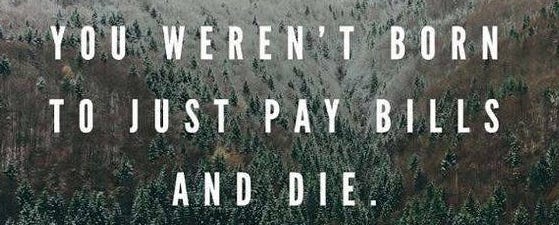
I loved that phrase, and I wrestled with it. Because Nick eventually did what the phrase demanded — he left Georgetown one day, wild and free, and went to travel the world, and he never really came back, and I watched him from my desk in a windowless building on Wisconsin Avenue and felt something complicated. Something that was equal parts awe and longing and a particular kind of self-doubt that asks: why aren’t you doing that? What are you waiting for?
But I also wasn’t Nick. I was also the woman who pinned engagement rings on Pinterest on Sunday evenings with her roommates, laughing over wine, talking about weddings and what marriage might feel like, and meaning it. Both things were true. Both versions of me were real. I just didn’t have a sign for that yet.
A year or so into my time at Georgetown, I started dating someone. I’ll call him K.
K was a little older, a finance guy, a stats guy, someone who wore business clothes on weekdays and had a warm, wonderful group of college friends who I fell in love with quickly — the kind of friends who host Sunday dinners and play board games and watch Game of Thrones together every week and call it Family Dinner and mean it. I loved those people. I genuinely, achingly loved those people.


K himself was soft and thoughtful and very, very certain about his life path. He was going to Wharton. Then one of the big three consulting firms. Then a family. He had the map drawn. And for a long time, I thought maybe I wanted that map too, or something like it. Stability again. The promise of something solid.
We commuted between Philadelphia and D.C. on weekends. Sometimes, D.C. and New York in the summer for an internship he was doing at a FinTech startup. It was romantic in that exhausting way long-distance is romantic, the compressed joy of reunions, the particular intimacy of two people building something across distance. I loved him. I trusted him. I leaned on him… especially when my job at Georgetown started to feel wrong.
And it had started to feel very, very wrong.
Nick had left Georgetown by then, and his absence was felt the way all good people’s absences are felt — in the specific silence where their energy used to be. We used to instant message each other throughout the day, a game we called ‘have you cried in your cube today,’ sending each other memes and sad little BuzzFeed articles until one of us finally broke. Without him, the windowless building felt more windowless. I had gotten two promotions. The health insurance was great. My boss had taken a real chance on me, and I was grateful for her, genuinely. But I was grey inside. The kind of grey that doesn’t announce itself, just settles slowly, like the weather.
So I started thinking about my next chapter, applying for jobs here and there, and letting my curiosity lead me into conversations with friends on different life paths and careers.
And then, two job offers arrived at once.
The first was to become an Assistant Store Manager at SoulCycle in D.C. This was the absolute peak of SoulCycle’s cultural moment — if you were alive and paying attention in 2015, you know. I had been riding for years by then, first on Nick’s buddy pass, then on my own. I had fully, completely, unironically drunk the Kool-Aid. The idea lit me up.
The second was for a customer success role at a startup in Chattanooga, Tennessee. My “hometown.” And not just any startup — RootsRated, which was essentially AllTrails before AllTrails existed, a platform for the outdoors and adventure, built in part by a friend of mine named Jake, one of the first three people to work there. I had been pestering Jake about this company since it started. Every outdoor-loving bone in my body had been quietly circling it for years. It felt true in a way that’s hard to articulate — the kind of thing that fits a version of yourself you’re still growing into.
But it meant leaving D.C. It meant leaving K’s ecosystem. It meant taking a bet on something small and uncertain over something stable and known. It meant changed priorities, and I didn’t have a sign for that yet. I only had the guilt.
It was spring tipping into summer in D.C. K had just graduated from Wharton and was moving into my tiny studio on Wisconsin Avenue. I had just adopted a dog (eee tiny Scout!). And K and I had a camping trip planned with friends over Memorial Day weekend. But the deadline for the job decisions was closing in like a weather system I couldn’t outrun.


In the car on the way to the campsite, Scout in the backseat, K gave me his opinion. He thought I should stay at Georgetown. It would be the most stable option while we figured things out together.
He wasn’t wrong. I knew he wasn’t wrong. And yet something inside me buckled like a chair with one leg shorter than the others — unstable under any real weight.
I wanted to trust him. I loved him. I had built my daily life around his orbit. So I said okay. I wasn’t saying okay to Georgetown, but I’d turn down RootsRated, narrow it to Georgetown and SoulCycle to stay in D.C., and then I’d decide in the next few days.
When I called RootsRated to say no thank you, my tongue felt like it had been borrowed from someone else’s mouth. Heavy. Wrong-fitting. I hung up and felt a sadness I couldn’t name, so I set it aside the way you do when you can’t afford to look at something directly, and I held K’s hand, and we drove toward the campsite and our friends.
That evening around the campfire, I told everyone about the situation. I mentioned SoulCycle. There was laughter. Not cruel laughter — just that particular laughter of people who have decided, collectively, what counts as serious and what doesn’t. SoulCycle was not serious. I remember feeling it like a small punch I was supposed to absorb and agree with. I chuckled along. I moved on. The night continued with a game called “the finger game” (the easiest drinking game ever created, but still just as fun) and stories I still remember, and the particular warmth of a fire that makes everything feel safer than it is.
Later, K and I climbed into our tent and fell asleep.
And then, sometime in the dark, I woke up panicked.
Not metaphorically panicked. Physically, viscerally, shot-straight-up-in-my-sleeping-bag panicked, barely able to catch my breath, heart enormous in my chest. K woke up terrified beside me and stood up too fast to protect us from the bear that was obviously — obviously — attacking us, and immediately fainted from standing up too quickly, and crumpled back down onto his sleeping bag.
We lay there in the dark, both slightly stunned. He came to. I started crying.
I told him I couldn’t say no to RootsRated. I told him, through tears, that I had wanted it for too long. That I had to go. That I was so sorry, that I knew what it meant for us, that it was going to make everything so hard, but that I needed to do it. I needed to do more than pay bills and die. The words came out of me like something that had been waiting at a door for a very long time.
K held me and kissed my forehead and said, “Hey, it’s okay. We can figure this out.”
The truth had named itself. Not because I had decided to be brave. Because the body got there first.
In the weeks that followed, I gave notice at Georgetown. I celebrated with friends — goodbye parties, nights out, the particular bittersweet joy of being toasted by people you love right before you leave them. One of those nights, K and I went dancing. We were walking home after the city did what D.C. does in early summer, warm and alive and impossible to leave, and K turned to me and said, quietly, that he would never move to Tennessee. That he wouldn’t find work there. Not with one of the big three.
I walked ahead of him for the rest of the walk home. Tears on my face, city lights blurring.
I wasn’t surprised. Some part of me had known. In vino veritas, my high school friend used to say — drunken words are sober thoughts — and this wasn’t even drunken, this was just the truth, said out loud finally, on a warm night in a city I was already leaving.
K helped me move to Chattanooga. He loaded the truck and drove the U-Haul behind my car…. and we tried, for a little while longer, to hold what we had built across the new distance. But Tennessee and the big three consulting firms don’t exactly overlap on the map, and we both knew it, even if we didn’t say it yet. He made it two visits before I called it off — sitting with the phone in my hand, missing him already, heart breaking, knowing I was choosing something I couldn’t fully name yet over something real and good and warm that I absolutely could.
There’s no clean moral to that part of the story. I loved K. I think he loved me. We just wanted different futures.
And I’ve been carrying that — all of it, Nick’s phrase, the campfire dark, the walk home, the weight of the choosing — for ten years now. Turning it over. Adding to it. Finding new versions of the same crossroads in different cities, different chapters, different versions of myself I hadn’t met yet.
Which is maybe why, walking through Edinburgh on a quiet night, I turned a corner and felt something stop inside me.
The shift had already happened before I named it. The panic attack in the tent wasn’t the moment I changed my priorities — it was the moment I stopped pretending I hadn’t. The truth had been building quietly for months, for years maybe, in the grey feeling in the windowless building, in the heavy tongue when I called RootsRated to decline, in the way Nick’s phrase lived rent-free in my chest even when I was trying to build a life that looked nothing like his.
The sign didn’t create anything. It just named something that was already true.
And the thing I keep returning to — the thing I think we don’t talk about enough — is how much energy we spend not posting the sign. Changing quietly. Shifting without announcement. Becoming someone slightly different than who we introduced ourselves as, and then carrying the weight of the discrepancy like a private debt.
We’ve been taught that changing your priorities is a kind of confession. An admission that you were wrong before. A betrayal of the people who loved the old version, or the plans you made together, or the self you presented so confidently. We apologize for our evolutions. We minimize them. We wait for someone else to notice and give us permission.
But that Edinburgh sign didn’t apologize. It didn’t hedge. It didn’t say ‘priorities may be subject to change’ or ‘priorities changing, sorry for the inconvenience.’ It said: Changed priorities ahead. Matter-of-fact. Declarative. The city just posted it on a lamppost and kept moving.
What if we gave ourselves that same grace?
I’m still figuring things out. There are shifts happening in my life right now that I’m not ready to write about yet — things I’m still feeling my way through, still in the tender middle of, not yet in the stark reflective place where you can tell the story cleanly. That’s okay. I don’t need to have it all mapped before I put up the sign.
What I know is this: the woman who woke up panicking in a tent in the Virginia woods ten years ago was not confused. She was not flaky, not disloyal, not a person who didn’t know her own mind. She was a person whose priorities had changed, and the truth of that was so urgent it woke her up in the dark because she had been trying to sleep through it.
The shift was already there. The sign just finally said so.
I think about all the times I’ve changed direction and felt the need to explain myself, justify the pivot, convince everyone — convince myself — that it was okay, that I had good enough reasons, that it wasn’t a betrayal of who I had been. I think about all the energy spent on that apology tour. And I think about that red sign on that Edinburgh street, calm and certain and completely unbothered, and I think:
What if we just... posted the sign?
No apology. No extensive footnotes. Just: this is where I am now. Adjust accordingly. Changed priorities ahead.
The road continues either way… It always does.
If this resonated, I’d love to know. Share it with someone who needs permission to post their own sign.
Sometimes the hardest part isn’t the changed priority, but realizing other people were still planning their lives around the version of you that had already begun to disappear. Why do you think we’re taught to treat changing priorities like confession instead of recognition?
"The panic attack in the tent wasn’t the moment I changed my priorities — it was the moment I stopped pretending I hadn’t." Woah! You nailed it. Thank you for sharing.